Retrieval lab
The retrieval lab (web app, Retrieval lab in the side navigation,
/{domain}/retrieval-lab?q=<question>&budget=<tokens>) shows what an agent would find for a
question, and how the answer changes with the search parameters. It calls Keeper's existing
read endpoints with the signed-in user's credentials; nothing in it calls a model.
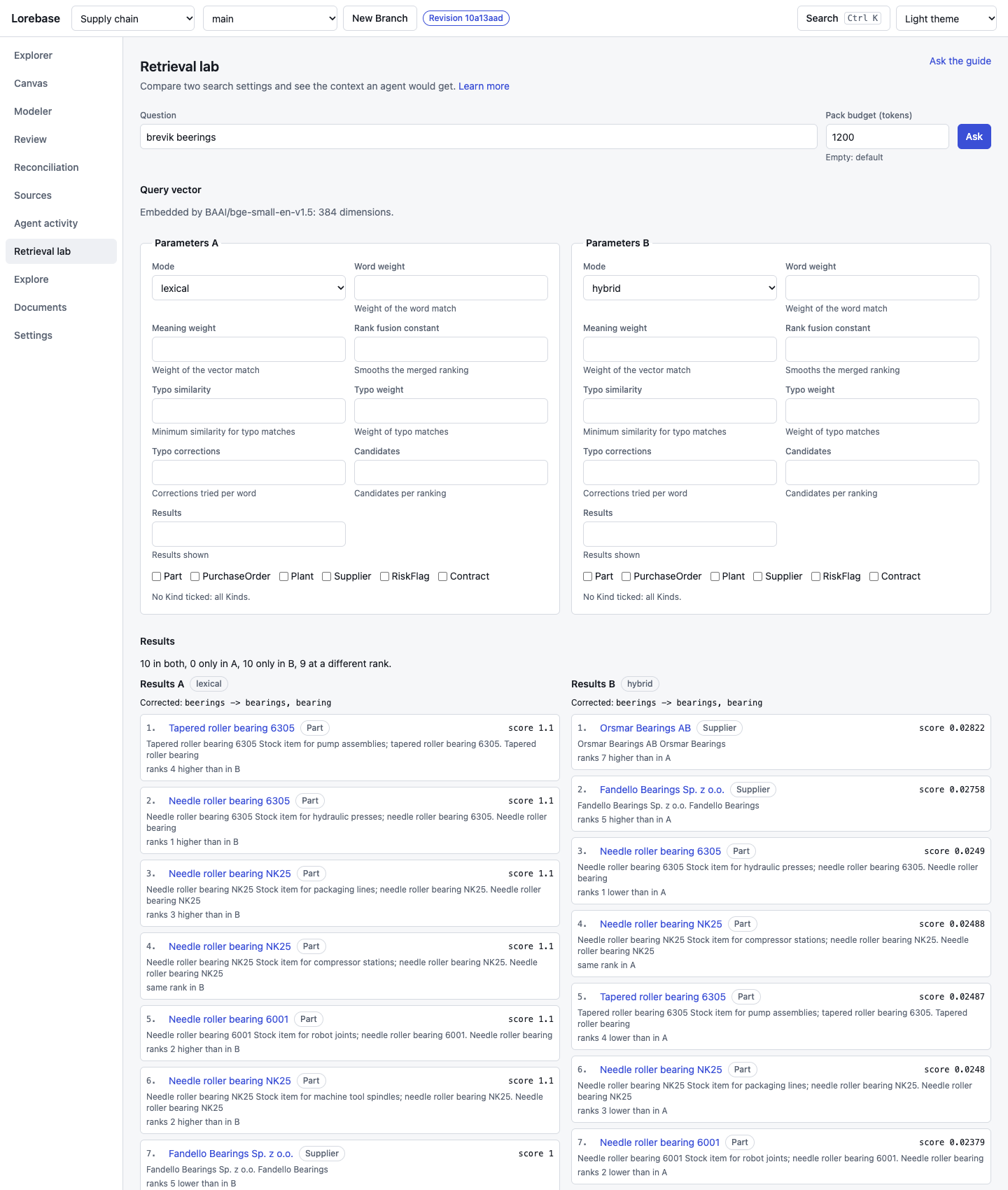
What it shows
- Two parameter sets side by side (A and B): mode (
lexical,semantic,hybrid),lexical_weight,semantic_weight,rrf_k,trigram_threshold,trigram_weight,typo_candidates,candidates, the result limit and a Kind filter. Each column lists its hits with score and snippet (shown as text), the typo corrections applied, and how each hit moved compared with the other set (new, gone, rank up or down). - The context pack an agent would receive for the question (
POST /contextwithsearch: <question>and the budget you give, or Keeper's default): seeds, neighbors and Links, each with why it is in the pack (matched the search; reached at depth N through Relation R from a seed or neighbor), the tokens used against the budget per section, and what trimming removed. - The involved Records on the Canvas: hits of both sets and the Records of the pack, with the pack's Links, highlighted.
The parameter sets are sent as tuning on POST /search, which replaces the search
settings for that one request:
{"q": "bearing", "kinds": ["Part"], "limit": 10,
 "tuning": {"lexical_weight": 1.0, "semantic_weight": 2.0, "rrf_k": 30,
            "trigram_threshold": 0.4, "trigram_weight": 0.5, "typo_candidates": 2,
            "candidates": 100}}
Unset knobs keep their configured value. candidates, typo_candidates and
trigram_threshold bound the work of a search, so they may only make it smaller: the first two
lower, the threshold higher (otherwise 422, pointer /body/tuning/<name>). Authorization, masking and limits are those of any search.
Query vectors
Semantic and hybrid search need the query's embedding in the model and dimension the Domain
is configured with (search.semantic.model, store.embeddings.dims). Keeper never computes
it. The lab gets one in two ways:
- Paste a vector (a JSON array of numbers), for example the output of
lorebase-inference embed --query "your question". - Guide, called by the browser: set
guideUrlin the web app's runtime configuration (/config.js, orVITE_GUIDE_URLat build time). The lab then sendsPOST {guideUrl}/embedwith{"text": "<question>", "mode": "query"}and the user's own Keeper credential (the bearer token, or the session cookie and CSRF header in session mode), and reads{"vector": [...], "model": "...", "dims": 384}. Guide must list the web app's origin (guide.http.allowed_origins), and the web app's Content-Security-Policy must allow it inconnect-src(the web image adds the origin ofVITE_GUIDE_URL). Every question asked in the lab, including one in a shared lab URL, is sent to Guide.
Without either, the lab searches lexically and says so; a set left on semantic or hybrid is searched lexically with a warning.
When guideUrl is set, the lab also reserves a place for an Explore panel (an optional
read-only exploration service working with the caller's own credentials); without guideUrl
nothing is shown.
Related
- Agent trace: what an agent actually asked and touched, step by step.
- Agents: context packs, budgets and trimming.
- Search settings:
searchinconfig/lorebase.example.yaml(reference).