Guide: the optional exploration assistant
Guide answers questions about a Domain by reading it, step by step, with a small read-only agent, and embeds query texts for semantic search. It is an optional service: Keeper, Herald, Scribe and the web app work the same without it.
- Package:
packages/guide(lorebase_guide), console scriptlorebase-guide. - Endpoints:
POST /embed,POST /explore(server-sent events),GET /healthz,GET /readyz. - Settings: the
guidesection (configuration reference); the models come from theinferencesection. - Deployment: compose profile
assistant(serviceguide), Helm valueguide.enabled(off by default), runtime web configurationguideUrl(VITE_GUIDE_URL).
Why it is separate from Keeper
Keeper and Herald never call a model (design 2.3,
AC-30): the read path is deterministic, cheap and auditable, and the build refuses an import of
lorebase_inference from either of them. Guide is the other side of that line. Besides Scribe it
is the only package allowed to use lorebase_inference, and it reaches Lorebase only through
Keeper's REST API with the Python client, exactly like an external agent:
- it has no database credential and no Keeper credential of its own;
- every read carries the caller's credential, so RBAC, sensitivity masking, row-level security, quotas, rate limits and the audit of reads apply to the user exactly as they would without Guide in between;
- it has no write tool: it cannot run Operations, open Proposals or change a branch;
- turning it off removes model cost from interactive use entirely.
The import contracts (.importlinter) enforce the direction: guide may import platform,
inference and client; keeper, herald, store and core may not import guide.
Endpoints
POST /embed
Answers {"model", "dims", "mode", "vector"}. mode: query puts
inference.embeddings.query_prefix before the text; mode: document puts document_prefix, as
Scribe does before storing a Record's vector, so the same text gives the same vector. model is
the name vectors are stored under, which Keeper advertises in GET .../schema (search.embedding);
compare both before using the vector in query_vector. The text is limited to
guide.limits.max_embed_chars.
POST /explore
{"domain": "supply", "branch": null, "question": "Which suppliers of Contract C-9 are in Italy?",
 "max_steps": 6, "budget": 20000}
max_steps and budget (tokens) can only lower the configured budgets. The answer is a stream of
server-sent events, each a JSON object:
| Event | Data |
|---|---|
session |
session_id of the agent trace, domain, branch, model (the configured chat model; null when the provider does not name one), max_steps (effective step budget of this run) |
thought |
step, text: the model's short reasoning note before its next action |
tool_call |
step, tool, args: one Keeper read |
tool_result |
step, tool, ok, summary, refs (Records the read returned) |
error |
code (budget, timeout, model), message; an answer follows |
answer |
text, citations (ref, kind, key), found |
done |
session_id, steps, outcome, tokens (input, output), elapsed_ms |
The tools are reads only: schema, search (lexical, or semantic and hybrid with a query vector
from the same embedding model when Keeper advertises it), query (the query DSL), get, links,
neighborhood, traverse, history, lineage and context (a context pack). An answer may only
cite Records that a tool returned during the exploration; when the model cites nothing it was
shown, or says the graph does not hold the answer, the answer is Not found in the graph. with
found: false.
Errors before the stream starts are problem documents (application/problem+json) with a code:
401 unauthorized, 403 origin_not_allowed, cross_site or csrf, 411, 413, 422, 429 rate,
concurrent or busy (with Retry-After), 502 keeper_unavailable.
Authentication
Guide accepts the same credentials as Keeper and forwards them unchanged; it never substitutes a credential of its own.
| Caller | Sends | Guide forwards |
|---|---|---|
| Web app in token mode, CLI, scripts | Authorization: Bearer <OIDC token or API key> |
the same header |
| Web app in session mode, with Guide behind the web app's origin | Keeper's session cookie and the session's CSRF token in X-CSRF-Token |
that one cookie and the token, nothing else |
| Local stack with Keeper in auth mode none | nothing, only with guide.http.allow_anonymous: true |
nothing |
Before any model call, and before the caller counts against any limit, Guide asks Keeper who the
caller is (GET /auth/whoami with the forwarded credential): an unknown, revoked or expired
credential is refused with 401 and costs no token. At most
guide.limits.max_concurrent_verifications such checks run at once; further requests are
refused with 429 busy. A session cookie whose value is not shaped like a Keeper session id is
refused without being forwarded. For a
session cookie Guide also reads the session's CSRF token from Keeper (GET /auth/session) and
refuses the request unless it matches the header: Keeper checks CSRF only on unsafe methods, and
an exploration makes reads, so without this check a cross-site page could spend the user's model
budget with the cookie alone. The cookie name is guide.http.session_cookie (with
keeper.auth.sessions.cookie_secure, the browser holds __Host-<cookie_name>); session mode needs
Guide under the same site as the web app, for example behind the same reverse proxy, because the
browser sends the cookie to that origin only.
Browser requests must come from an origin listed in guide.http.allowed_origins, which is also the
CORS allow-list; a request whose Origin is not listed, or marked Sec-Fetch-Site: cross-site
without an Origin, is refused with 403. While allowed_origins is empty, guide.http.default_origins
applies instead; the compose file sets it to the origins of its web service, so GUIDE_ALLOWED_ORIGINS=[]
in .env behaves as unset and Guide logs a warning at start.
Agent trace
Each exploration is one agent trace session (guide-<hex>). Every Keeper request it makes carries
X-Lorebase-Session, the opt-in X-Lorebase-Trace: on and X-Lorebase-Tool: guide.<tool>, so
Keeper's agent trace records the timeline of the reads, filtered for the viewer like any trace. The
model's reasoning notes are posted to POST /api/v1/trace/sessions/{session}/notes with the
caller's credential and the Domain id. Posting a note is a write (to Keeper's trace store, not to
the Domain); guide.trace.notes: false keeps the trace headers and posts no note. Notes are
model output shaped by graph data, so whoever displays them (the trace timeline, the Explore
panel) must render them as untrusted plain text. Notes are best effort: a Keeper with tracing off or without
the route never fails an exploration, and after a refusal no further note of that session is sent.
Header names, the notes path and the note length are in guide.trace; guide.trace.enabled: false
sends neither headers nor notes. The session event gives the web app the id to link to the
session's timeline.
The Explore panel in the web app
The web app asks Guide from Explore, a screen of its own in the navigation
(/<domain>/explore); the Retrieval lab links to it ("Ask the guide"). It appears when the
runtime configuration has guideUrl; against the mock API it plays scripted explorations
instead, so it can be tried without Guide.
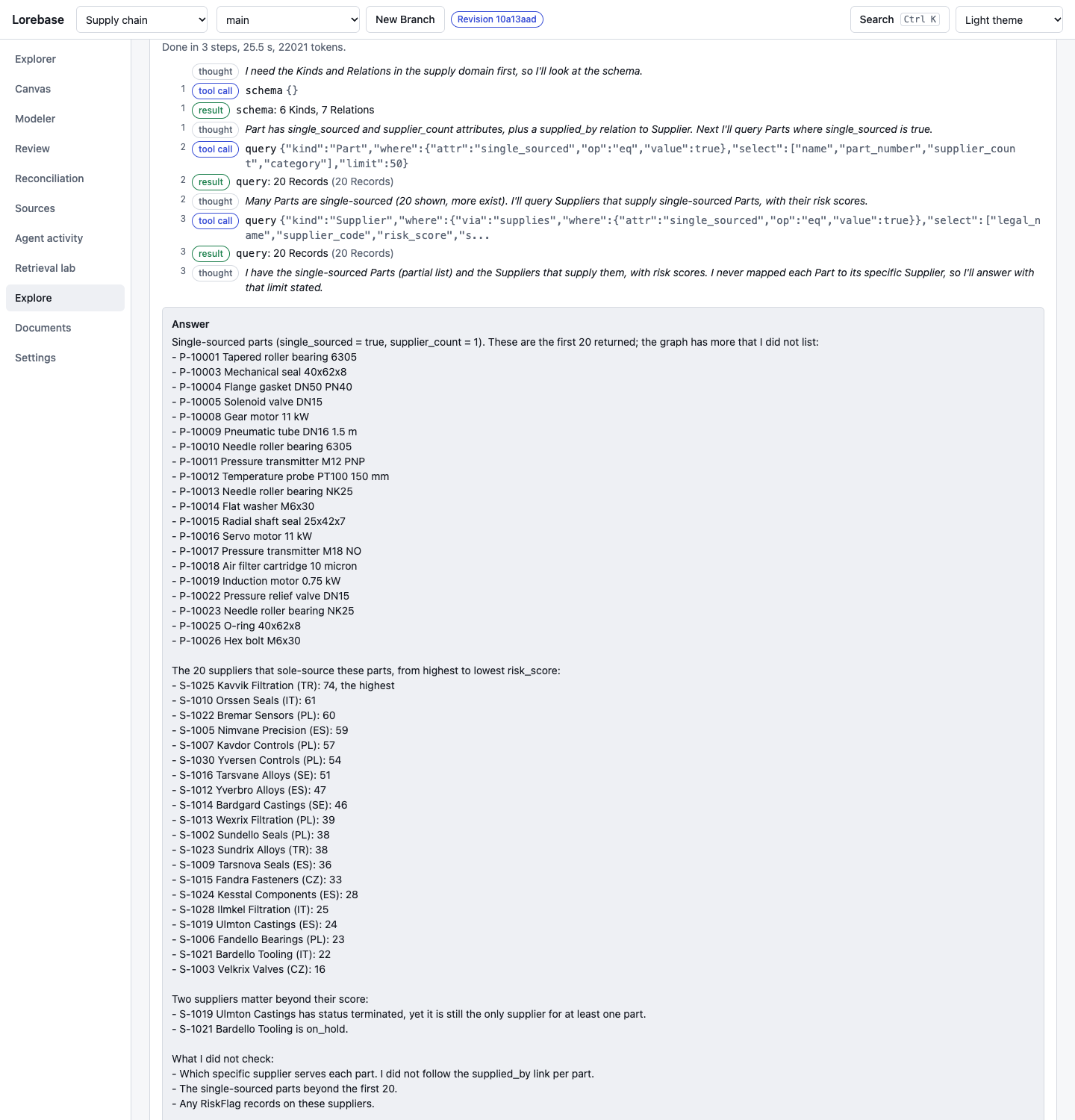
- Request.
POST {guideUrl}/explorewith the Domain, the Branch on screen (nullfor the default one), the question and the panel's max steps (VITE_EXPLORE_MAX_STEPS, 6; Guide only ever lowers its own budget).guideUrlis an absolute origin (https://guide.example.com) or a path on the app's origin (/guidebehind the web proxy); session mode needs the second. - Credentials. In token mode the same
Authorization: Bearerheader Keeper gets; in session mode the session cookie (credentials: include) and the CSRF header of the session. The client holds no credential or setting of Guide's. - Streaming. The response is read with
fetchand a stream reader, sinceEventSourcecannot POST. Each event is shown as it arrives: reasoning notes, tool calls with their arguments on one line, results with their summary and the number of Records, anerrorevent, then the answer and the totals ofdone(steps, seconds, tokens). The model name is shown when an event carriesmodel. - Stop and limits. Stop aborts the request, which closes the stream; Guide stops working
on the exploration. The panel stops a stream that runs longer than
VITE_EXPLORE_TIMEOUT_MS(150 s, aboveguide.agent.timeout_s). A 429 shows its reason and disables asking untilRetry-Afterhas passed; other refusals show what thecodemeans. - Untrusted text. Notes, summaries, arguments and answers are rendered as plain text: no
HTML, no Markdown, no links or images, whatever they contain. Only
citationsbecome links, to the Record pages of the app, when the Kind is a valid name of the Domain's schema and the key holds no control character; others are shown as text. "Show cited Records on the Canvas" draws them with their neighbors. - Trace. "View trace" opens the session of the
sessionevent in Agent activity (/<domain>/agent-activity?session=<id>). - Example questions. The panel offers the questions a Domain declares in its schema
(
domain.examples, see schema as code) as buttons, and nothing when it declares none; the Retrieval lab offers the same questions as quick picks. The app itself holds no questions of any dataset. Thesupplyexample declares the questions of the example agent: single-source risk, tier-1 suppliers at high risk with open orders, what if S-1007 stops, the history of C-3013 and a misspelled search ("bering").
Budgets and limits
| Setting | Default | Bounds |
|---|---|---|
guide.agent.max_steps |
8 | tool calls; then one last turn to answer |
guide.agent.max_tokens_per_call |
1024 | completion cap of one model call, never above what remains of the total after the estimated input |
guide.agent.max_total_tokens |
40000 | input plus output tokens of one exploration |
guide.agent.timeout_s |
120 | wall clock of one exploration, model calls and Keeper reads alike |
guide.limits.explorations_per_minute |
6 | per credential |
guide.limits.max_concurrent_per_caller |
1 | per credential |
guide.limits.max_concurrent |
4 | per process |
guide.limits.embeds_per_minute |
120 | per credential |
Before each model call Guide estimates the input (prompt, accumulated messages and tool results)
from its length: 4 characters per token for the first call, then the ratio the endpoint's own
count of the previous call gives (JSON tool results measured about 2.2 characters per token on
Claude models). The call is made only if used plus estimated input still fits in
max_total_tokens; otherwise the exploration ends as below without calling the model. The
completion cap is cut to what remains after the estimate, so the total stays within the budget up
to the estimate's error; an answer of the final turn is kept even when the endpoint counted more
than estimated. Before each tool step Guide also checks that the budget covers that
step, the next call with a full tool result (max_result_chars) and an answer of
max_tokens_per_call; when it does not, that turn is the last one, as when max_steps is
reached: the model answers from what it has read, citing it, instead of the exploration
stopping with nothing. Only when even an answer no longer fits does the stream end with an
error event (budget), a Not found in the graph. answer and done. Rate windows and concurrency slots are keyed on the principal Keeper reported, so
several keys of one principal share them, and unverified credentials never enter them; the
window table holds at most guide.limits.max_tracked_callers callers, and while it is full of
callers active in the last minute a new caller is refused with 429 busy. Limits are per
process: with several replicas each enforces its own, and Keeper's rate
limits and quotas apply to the reads on top. Tool results shown to the model are bounded too
(max_result_chars, max_value_chars, max_items, max_depth, max_nodes,
max_context_tokens).
Setup with Ollama
The default chat model is the local Ollama one of inference.llm; Guide uses the task named by
guide.agent.task (explore), so the exploration model can differ from the extraction one:
inference:
  llm:
    base_url: http://ollama:11434/v1
    model: qwen2.5:7b-instruct
    tasks:
      explore: {model: qwen2.5:14b-instruct, max_concurrency: 2}
guide:
  keeper: {base_url: http://keeper:8080}
  http: {allowed_origins: ["http://localhost:5173"]}
make up PROFILES=assistant      # Guide and Scribe, with the web app pointed at /guide
docker compose --env-file .env -f deploy/compose/docker-compose.yaml \
  --profile local-models up -d ollama ollama-pull     # the model server, when it runs in compose
make up PROFILES=assistant (or make up-assistant) builds the lorebase-ml image for Guide and
Scribe, starts both next to the default services and adds the overlay
deploy/compose/assistant.yaml: the web app reads Guide at /guide and Guide accepts calls
without credentials, which suits only a Keeper in auth mode none (quickstart).
Without the helper, add --profile assistant and -f deploy/compose/assistant.yaml to the
compose command. make down stops the profile too.
/embed and semantic search need the embedding model Scribe uses. The lorebase-ml image
(target backend-ml of deploy/docker/backend.Dockerfile) is the backend image plus fastembed
and one embedding model baked in at build time (EMBEDDING_MODEL, default
BAAI/bge-small-en-v1.5), so Guide and Scribe embed offline with a read-only root file system.
It is 391 MB larger than the backend image, which is why only Guide and Scribe use it; in the
Helm chart it is imageMl. Or point inference.embeddings at an OpenAI-compatible endpoint and
use the backend image. Without a usable embedding model, /embed answers 502 and the agent
searches lexically.
Setup with Anthropic
Anthropic serves an OpenAI-compatible endpoint, so no vendor library is involved
(inference providers explains each option). Send only the
exploration task there, and keep the key in a file (a Kubernetes or compose secret) referenced
with secret://file; never put it in the YAML or in an environment variable:
inference:
  llm:
    tasks:
      explore:
        base_url: https://api.anthropic.com/v1/
        model: claude-haiku-5-5
        api_key: secret://file//run/secrets/anthropic_api_key
        headers:                           # organization-level keys only
          anthropic-workspace-id: secret://file//run/secrets/anthropic_workspace_id
        temperature: null
        json_schema_strict: true
        extra_body: {thinking: {type: disabled}}
        price_per_million_tokens: {input: 0.10, output: 0.50}
guide:
  agent:
    max_tokens_per_call: 2048              # 4096 with claude-sonnet-5-5 or claude-opus-5-5
Which model, from the live runs (eight questions on the supply
sample, three runs each, answers checked against the data):
| Model | extra_body |
Mean score | Cost per question | Median time |
|---|---|---|---|---|
claude-haiku-5-5 |
{thinking: {type: disabled}} |
0.83 | 0.003 USD | 11 s |
claude-sonnet-5-5 |
{thinking: {type: between_tools}} |
0.85 | 0.058 USD | 16 s |
claude-opus-5-5 |
{reasoning_effort: low} |
0.91 | 0.10 USD | 20 s |
Haiku 5.5 is the recommended exploration model for hosted setups: it answered every lookup and
most multi-hop questions correctly at a twentieth of Sonnet's cost. Opus 5.5 was the most
accurate on the multi-hop questions; use it where an answer's completeness matters more than
cost. Sonnet 5.5 was not better than Haiku on these questions. With max_tokens_per_call at
2048, 3 of 48 Sonnet and Opus runs ended with error model (an answer that did not parse
after the repair call, most likely cut off by the cap: Opus thinks within it); at 4096 none of
16 further runs did. Guide's log line model call failed now names the schema problems
(/: json for an answer that is not JSON) and counts the tokens of such calls. The default budgets fit: runs used
1 to 8 steps and at most 37,000 tokens.
A task on another base_url uses only its own api_key and headers: the main key and headers
are never sent to an endpoint they were not configured for. The step schema has a free-form
args object, which the strict mode of the endpoint may refuse; the client then steps down to
prompt-only structured output and every answer is still validated locally. The mode an endpoint
accepts is remembered per endpoint, model and output settings (a SHA-256 of them, never the
address) in guide.mode_memory_file under guide.data_dir
(~/.local/state/lorebase/guide/structured_output_modes.json by default), written atomically
under an exclusive lock (a .lock file next to it), so a restarted Guide does not try the
refused mode again. Entries carry a timestamp and expire after inference.mode_memory_ttl_s
(7 days); lorebase-guide modes clear deletes the file's entries. The compose stack mounts the volume
guide-data at /var/lib/lorebase/guide and the Helm chart an emptyDir
(guide.persistence.enabled keeps it on a claim); mount a volume there in other containers to
keep it; when the file cannot be read or written, Guide logs a warning and remembers the mode
for the life of the process only. Embeddings stay on fastembed or another provider: Anthropic has none.
Security model
- Read-only by construction. The tool catalogue is closed and holds reads only; arguments are validated before a request is made; there is no URL fetching and no tool reaches anything but Keeper. An unknown tool name is reported to the model as an error and does nothing.
- Caller's authority only. Every Keeper request carries the caller's own credential, checked by Keeper before the first model call. A reader limited to one Kind sees, through Guide, exactly what that reader sees without it.
- Graph data is untrusted. Records, titles, snippets and change messages may come from anyone allowed to write, or from documents. Each tool result reaches the model inside a block delimited by a random marker chosen per exploration and removed from the data, so the data cannot close the block; the instructions say that nothing inside is an instruction. Whatever the model is led to do, it can only read with the caller's rights and answer: citations are limited to Records a tool returned data for.
- Plain-text rendering.
thought,summaryandanswertexts are model output and may quote graph data: clients render them as plain text, never as HTML or Markdown with links or images. The web Explore panel shows answers as text and turns only thecitationsinto links, to the Records' own pages inside the app; it never follows or renders a URL found in a text. - Cost. Authentication before model work, per-credential rate and concurrency limits, a total concurrency cap, per-call and per-exploration token caps and a wall-clock timeout.
- No values in logs. Logs and metrics hold counts, tool names, outcomes and durations; never questions, data, answers or credentials. The access log has method, route, status and duration, and the HTTP client's own request log (which names URLs, so Record keys) is kept at WARNING.
- Paths. Record refs, relation names, Domains and branches become URL path segments only
through the client, which percent-encodes them and refuses empty,
.and..segments, so no value can move a request to another Keeper route. - Network. Guide needs Keeper and the model endpoint only; the Helm network policy allows nothing else.
Observability
Traces (guide.model, guide.tool spans and one server span per request) and metrics
lorebase.guide.requests, lorebase.guide.request.duration, lorebase.guide.explorations
(by outcome), lorebase.guide.steps (by tool and success), lorebase.guide.tokens (by
direction), lorebase.guide.embeddings and lorebase.guide.refused (by reason), exported when
telemetry.otlp_endpoint is set. /readyz checks that Keeper answers /healthz.